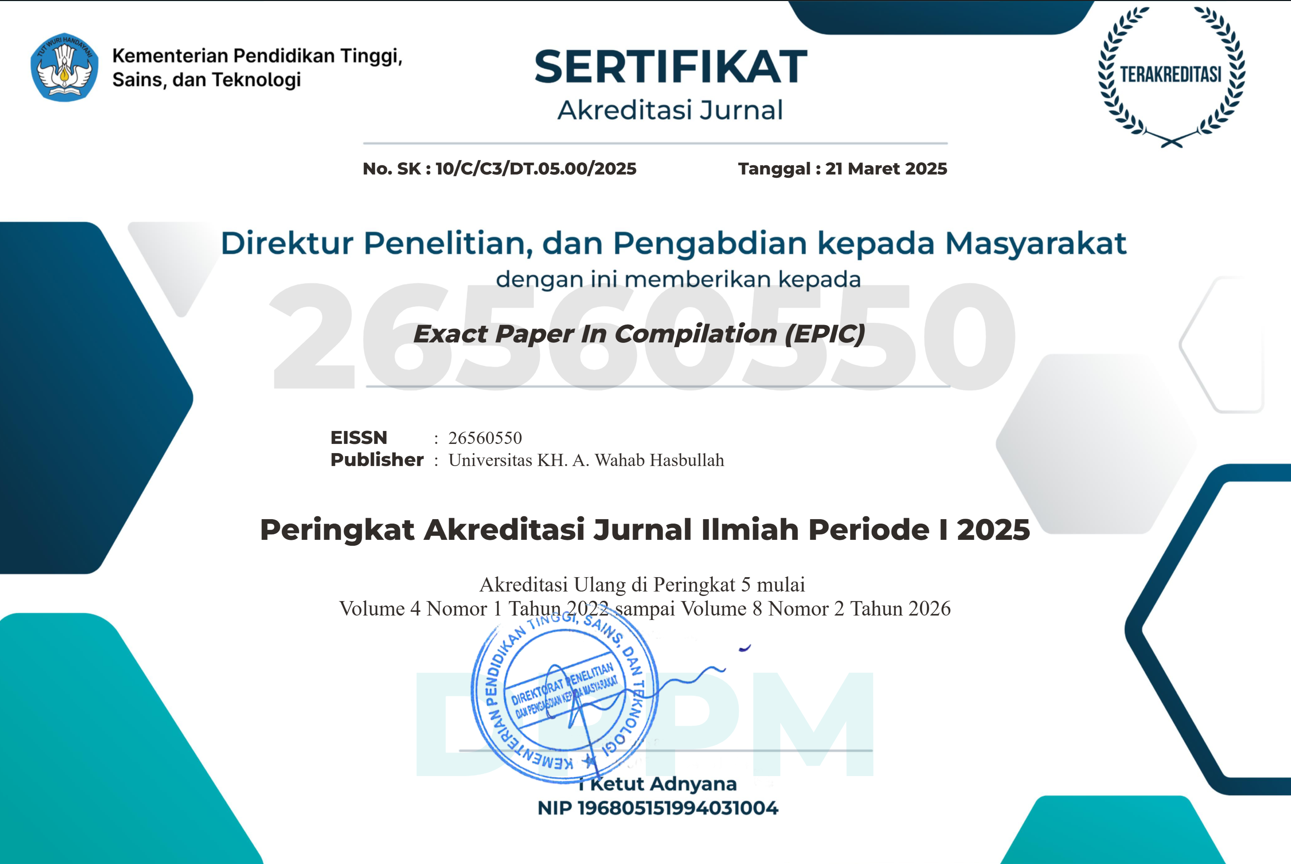
Certificate

Journal EPiC is committed to protecting the integrity of research and the scholarly record. The journal will assess credible allegations of research or publication misconduct involving submitted manuscripts or published articles, whether concerns are raised before or after publication.
An allegation does not, by itself, establish misconduct. Concerns will be evaluated fairly, impartially, and on the basis of available evidence. Honest errors and legitimate differences in scientific interpretation will be distinguished from misconduct.
This policy covers suspected research misconduct and related breaches of publication ethics, including:
Authors, reviewers, readers, institutions, and other concerned parties may report suspected misconduct through the official editorial contact listed on the journal’s Contact page.
To support a meaningful assessment, a report should provide, where available:
Anonymous reports may be considered when they contain sufficiently specific and verifiable information. Unsupported allegations alone will not be treated as proof of misconduct.
The Editor-in-Chief, or an editor without a relevant conflict of interest, will conduct an initial assessment of the report. This assessment will consider the credibility and specificity of the information, its relevance to the journal’s content, and the potential effect on the reliability or attribution of the work.
Where necessary, the journal may consult independent subject specialists, statistical reviewers, or research integrity advisers. Editorial consideration of a manuscript may be paused while a serious concern is assessed.
When an allegation warrants further assessment, the journal will normally contact the corresponding author and, where appropriate, other authors or relevant parties. Those concerned will be informed of the substantive issues and given a reasonable opportunity to respond.
The journal may request supporting materials such as original data, analysis files, image source files, research protocols, ethical approval documents, or consent documentation, subject to applicable legal, ethical, and confidentiality requirements.
Responses will be evaluated against the available evidence. Failure to respond may require escalation or editorial action, but will not, by itself, be treated as conclusive proof of misconduct.
The journal’s role is to assess the integrity of the publication and determine appropriate editorial action. Formal investigations into researcher conduct are generally the responsibility of the relevant institution, employer, or authorized research integrity body.
Where serious concerns remain unresolved, the journal may refer the matter to the appropriate institution or authority and provide relevant evidence. The journal will cooperate with legitimate investigations and may request information about their progress and findings insofar as these affect the published record.
Editorial action may be necessary to protect readers while an institutional investigation is pending. Conversely, an institutional finding will be considered alongside the evidence relevant to the article when determining the appropriate publication response.
Editorial action will be proportionate to the nature of the concern, the available evidence, and its effect on the scholarly record. Possible outcomes include:
A correction or retraction may be necessary because of honest error as well as misconduct. Such notices are intended to protect the accuracy of the scholarly record, not to serve as punishment.
Information will be shared only with parties who need it for assessment, investigation, or an appropriate editorial response. Absolute confidentiality cannot be guaranteed where disclosure is necessary to provide a fair opportunity to respond, cooperate with an investigation, or meet legal obligations.
The journal will not dismiss a credible concern solely because it is raised anonymously or by a person with a competing interest. Reports made in good faith should be evaluated respectfully, and an allegation that is not substantiated will not automatically be regarded as malicious.
Editors or advisers with a relevant personal, professional, institutional, or financial conflict of interest must not make decisions on the case. Concerns involving the Editor-in-Chief will be referred to the publisher or an appropriately independent editorial representative.
The journal will communicate its editorial decision to the relevant parties to the extent permitted by confidentiality and legal obligations. Case handling times may vary according to the complexity of the evidence and the need for external investigation.
Corrections, expressions of concern, and retraction notices will state the reasons for the action and be clearly linked to the affected article. Notices will be updated or supplemented when subsequent findings require clarification.
Authors or complainants may request reconsideration by providing new evidence or identifying a specific procedural concern. An appeal should explain the grounds for review rather than simply repeat disagreement with the outcome.
Where feasible, an appeal will be assessed by an editor or representative who was not responsible for the original decision and who has no relevant conflict of interest.
In handling allegations, the journal will refer to relevant guidance from the Committee on Publication Ethics (COPE) and applicable institutional and legal requirements. Reference to COPE guidance does not imply that the journal is a COPE member.
 Download (DOCX)
 Submit Your Paper